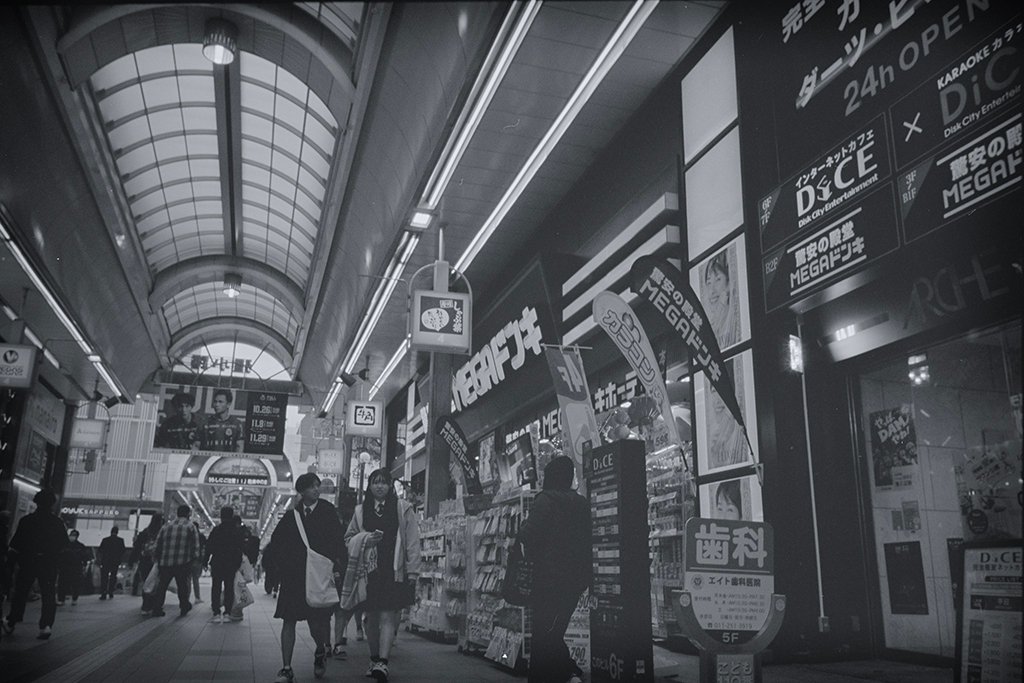
The Don Quijote store on Tanukikoji Shopping Street had a presence you could feel before you even saw it—an electric hum in the air, a density of color and noise that spilled out from its doors like a carnival trying to escape its tent. Even in the early evening, when the arcade lights glowed softly and shoppers drifted lazily between stores, Don Quijote pulsed with its own frantic heartbeat.
I wasn’t planning to go inside. I only meant to pass by, to enjoy the corridor of warm lights that stretched from one end of the street to the other. But Donki, as always, demanded attention. Its sign blazed overhead as though inviting—or daring—passersby to enter. Beneath the sign, the doors were wide open, like the mouth of some mythical creature that devoured time and spat you out an hour later with bags you didn’t remember choosing.
As I approached, the scent of sugar, plastic, and something lightly fried drifted out. Two teenagers emerged with bags full of Halloween accessories—though it wasn’t remotely close to Halloween—laughing as one of them wore a rubber mask pulled halfway up their forehead. A couple stood by the entrance comparing prices of travel-sized shampoos, pointing excitedly at a shelf inside. A tourist family clustered around the tax-free sign, strategizing their shopping as though preparing for battle.
Walking past Donki felt a bit like walking past a portal. The air thickened. The sounds sharpened. The world became brighter, exaggerated, almost theatrical. A loudspeaker crackled from within, launching into its familiar, hyper-cheerful jingle. It bounced off the arcade ceiling, echoing through the walkway like the anthem of some hyperactive kingdom. I couldn’t help smiling; no matter how many times I heard it, it made the whole street feel like a festival.
Outside, a row of gacha machines stood in obedient formation, their capsules gleaming under neon light: miniature ramen bowls, tiny police cars, bizarre cats, and souvenir charms shaped like cartoonishly cute Hokkaido vegetables. A man in his thirties hunched over a machine, turning the crank with the seriousness of a surgeon performing a delicate procedure.
I paused beside him, watching as the capsule dropped with a satisfying thunk. He held it up to the light, nodded approvingly, and walked away—mission accomplished.
Further ahead, the arcade continued into calmer territory, where the lights softened and the shops sold handmade goods rather than chaotic novelty. But for a moment, I stood anchored before Donki’s glowing entrance, mesmerized by the contrast: the quiet Sapporo night pressing in from the open ends of the street, and this riot of color and sound blazing defiantly in the middle of it.
A mother tugged her child’s hand gently. “We’re not going inside today,” she said.
The child stopped, stared at the entrance, then sighed dramatically—as if denied entry to a magical castle.
I understood the feeling. Donki was absurd, cluttered, overwhelming—and yet there was something irresistibly alive about it. Something joyful in its unapologetic chaos. It wasn’t just a store; it was a mood.
I finally took a step away, letting the hum recede behind me. The further I walked, the quieter the street became, the more the night returned to itself.
But even then, just at the edge of hearing, that bright, relentless jingle lingered—cheerful, absurd, unforgettable—as though Don Quijote, in all its neon glory, had stamped the moment with its signature.