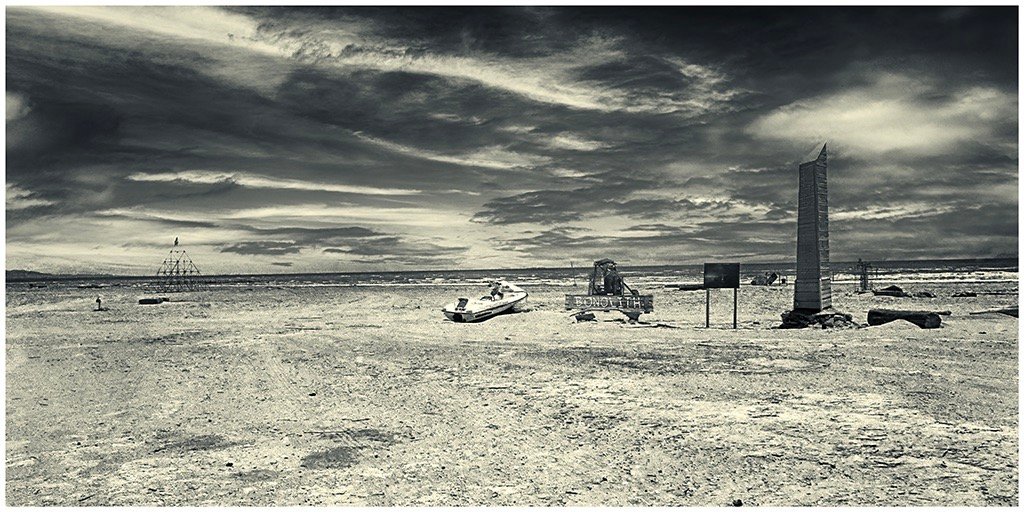
Shelley’s Ozymandias stands in a desert of his own making, sneering at a kingdom already gone. Here, the desert has returned the favor — not through sand and wind alone, but through water’s slow, indifferent withdrawal. The Salton Sea does not rage. It simply leaves. And in leaving, it unmasks everything.
The obelisk is Ozymandias made literal. Someone planted it here in an act of pure assertion — we were here, this mattered, look up. But the vertical ambition of stone cannot argue with horizontal desolation. The monument remains precisely because no one needs it anymore. That is the poem’s central cruelty, and the photograph’s: ruins persist longest after meaning has evacuated them completely. The boat is the detail that breaks the heart. It was built for water, purposeful and buoyant, now stranded in geological irony. It is every plan that made perfect sense when the conditions existed to support it.
Shelley’s sculptor “well those passions read.” So too the photographer. What the lens captures is not decay but exposure — the moment when all the scaffolding of human certainty is stripped away and the bare fact is revealed: we build, we name, we declare permanence. The desert simply waits to be proven right.